Start with the right asset class
Tokenization works best when the underlying asset has clear ownership, established provenance, and a market that already trades it. Before you mint anything, you need to pick an asset class that can survive the legal and logistical friction of blockchain settlement.
Not every luxury item is a good fit. Some assets are too illiquid, too expensive to insure, or legally ambiguous across jurisdictions. You want assets that behave like real estate or fine art: high value, tangible, and with a history that is easy to verify.
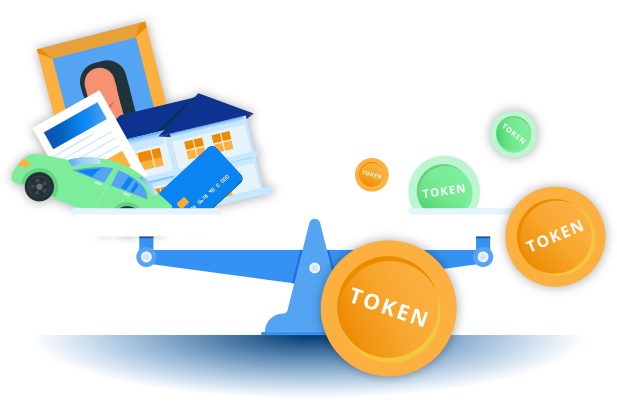
Fine art is the most mature category. Auction houses like Sotheby’s and Christie’s have already experimented with fractional ownership, and the legal frameworks for art provenance are relatively standardized. If you can verify the artist and the chain of custody, the asset is likely viable.
Luxury watches are the second strongest candidate. Brands like Patek Philippe or Rolex have robust authentication networks. The secondary market is deep, and the items are portable, making them easier to store and insure than real estate. Look for pieces with original boxes and papers to ensure the title is clean.
Real estate offers the highest liquidity potential but the heaviest legal burden. Tokenizing a vacation home or commercial property requires navigating local property laws, which vary wildly by country. This is viable, but it requires a legal team, not just a tech platform.
Avoid categories like designer fashion or jewelry unless they come from a brand with a built-in blockchain registry. Without that infrastructure, verifying authenticity and ownership becomes a manual, expensive nightmare that defeats the purpose of tokenization.
The goal is to pick an asset that is already liquid in the traditional market. If it’s hard to sell today, it will be hard to sell as a token tomorrow. Start with what is proven, not what is promising.
Set up legal and custodial frameworks
Before writing a single line of code, you must establish the legal and physical infrastructure that backs the token. Tokenizing a luxury asset is not just a tech upgrade; it is a legal restructuring. If the underlying entity or the physical item is not secured properly, the token is worthless.
Follow this sequence to build a compliant foundation.
Transfer ownership of the high-value asset into a Special Purpose Vehicle (SPV). This legal entity holds the asset exclusively, isolating it from the operational risks of your main business. The SPV becomes the sole owner, ensuring that the token represents a direct claim on the asset itself. This structure is essential for clear title verification and legal enforceability.
Place the physical asset in a professional, insured custodial vault. Whether it is fine art, jewelry, or vintage wine, the item must be stored in a high-security facility with rigorous insurance coverage. You need documented proof of storage and regular audits to prove the asset’s condition and existence to token holders.

Implement strict Know Your Customer (KYC) and Anti-Money Laundering (AML) protocols for all token buyers. This involves identity verification, source-of-funds checks, and adherence to local financial regulations. Without these controls, you risk regulatory shutdown and criminal liability. Use compliant on-chain identity providers to automate this process.

Write the smart contract to reflect the legal rights established in the SPV and custody agreements. The code should automate dividend distributions, voting rights, or redemption options exactly as defined in the legal docs. Ensure the contract includes pause functions and admin controls to handle legal disputes or regulatory changes.
This setup ensures that the token is not just a digital promise, but a legally enforceable claim on a real, secured asset. Skipping these steps creates massive liability and undermines investor trust.
Choose the blockchain infrastructure
Selecting the right ledger is the first technical decision in tokenizing luxury assets. Public chains like Ethereum offer deep liquidity and global accessibility, but they often struggle with the strict identity verification and transaction privacy that high-net-worth investors and regulators demand. Private or permissioned ledgers provide the control needed for compliance but can limit how easily tokens are traded.
The choice between public and private infrastructure dictates your operational costs, speed, and legal standing. For tokenized real estate or fine art, the ledger must support complex ownership structures and prevent unauthorized transfers. This section compares the two primary infrastructure models to help you align your technical stack with your regulatory requirements.
Public vs. Permissioned Chains
Public blockchains are open to anyone, providing maximum liquidity but requiring additional layers for compliance. Permissioned chains restrict access, offering higher privacy and faster finality at the cost of broader market reach.
| Feature | Public Chain (e.g., Ethereum) | Permissioned Chain (e.g., Corda) |
|---|---|---|
| Liquidity | High (open secondary markets) | Low (restricted investor pool) |
| Privacy | Low (transparent transactions) | High (private data channels) |
| Compliance | Requires external KYC/AML layers | Built-in identity verification |
| Cost | High gas fees during congestion | Lower, predictable transaction fees |
| Speed | Variable (block time dependent) | High (instant finality) |
Token Standards for Compliance
Once you select a chain, you must choose a token standard that embeds regulatory rules directly into the asset. Generic standards like ERC-20 are too flexible for luxury assets, which often require transfer restrictions.
ERC-3643 (T-REX) is designed specifically for compliant tokens. It integrates identity checks into the token contract, ensuring that only verified investors can hold or trade the asset. This standard is ideal for private equity or real estate funds where regulatory adherence is non-negotiable.
ERC-1400 is a modular standard for security tokens. It allows developers to define custom transfer rules, such as holding periods or investor limits. While more complex to implement than ERC-3643, it offers greater flexibility for assets with nuanced legal structures.
Note: Always verify that your chosen token standard is supported by your custodian and legal counsel before deployment. Incompatibility can lock assets or trigger regulatory violations.
Matching Infrastructure to Asset Type
Your asset class should drive your infrastructure choice. High-frequency trading assets benefit from public chains, while illiquid, long-term holdings like commercial real estate often perform better on permissioned ledgers.
For luxury goods with frequent secondary trading, a public chain with a compliant token standard offers the best balance of liquidity and control. For exclusive, high-value assets with a small investor base, a permissioned chain reduces regulatory overhead and protects investor privacy.
Launch tokens and manage liquidity
Once your luxury asset is verified and legally structured, the next phase is issuing the tokens and getting them into the hands of investors. This process transforms a static asset into a liquid financial instrument. You are essentially building the bridge between the physical item and the digital marketplace.
Select a blockchain that supports your specific asset class and investor base. Ethereum is the standard for high-value assets due to its security and liquidity, while Polygon offers lower fees for smaller fractional shares. Your smart contract must define the total supply, the value of each token, and the rights attached to ownership, such as voting or dividend distribution. Ensure the contract is audited by a reputable firm to prevent exploits.
Determine your distribution strategy. A private placement targets accredited investors and high-net-worth individuals, offering exclusivity and potentially faster fundraising. A public offering opens the token to a broader audience, increasing liquidity but requiring more rigorous compliance and marketing. Use a launchpad or a dedicated token sale platform to manage the transaction flow and ensure all participants meet KYC (Know Your Customer) requirements.
Liquidity is the primary benefit of tokenization, but it only exists if investors can sell. List your tokens on a licensed digital securities exchange or a decentralized exchange (DEX) that supports compliant assets. This allows holders to trade their fractional ownership without waiting for the underlying asset to be sold. Clear up-front liquidity attracts serious buyers who want an exit strategy.
Tokenization is not a "set and forget" model. You must continue to report financial performance, maintenance costs, and any changes in the asset's status to token holders. Smart contracts can automate dividend payments or voting, but the legal entity behind the tokens must remain active and compliant with securities laws in all jurisdictions where your investors reside.
Essential Tools for Tokenization
Managing tokenized assets requires a blend of technical and legal infrastructure. The following resources can help you manage the complexities of digital asset management and blockchain investment.


As an Amazon Associate, we may earn from qualifying purchases.
Avoid common fractionalization mistakes
Tokenizing high-value assets sounds like a shortcut to liquidity, but the execution often traps investors in illiquid positions. The primary risk isn't the technology; it's the structure. You might hold tokens representing a fraction of a vineyard or a yacht, but if the secondary market is thin or the smart contract has restrictive transfer windows, your asset is effectively locked. Treat these tokens like private equity, not public stock, and assume you cannot sell them on a dime.
Smart contract audits are non-negotiable. A single vulnerability in the code governing ownership transfers can freeze assets or allow unauthorized minting. Before committing capital, verify that the contract has been audited by a reputable firm and that the results are public. Don't rely on the platform's marketing materials; look for the actual audit report. If the code hasn't been stress-tested by independent security experts, the risk is too high.
Cross-border transactions introduce a tax labyrinth that many overlook. Tokenized assets often sit on blockchains that don't respect national borders, but your tax liability certainly does. StanTax notes that the legal and tax framework in the EU and France treats these tokens as digital securities, triggering specific reporting requirements. Ignoring these implications can lead to severe penalties. Consult a tax professional who understands both traditional asset law and blockchain mechanics before you buy.
Final validation steps
Before you launch your tokenized luxury asset, treat this as a compliance checkpoint rather than a formality. High-stakes fractional ownership requires airtight legal structures to protect both the issuer and the investor.
- Verify your legal entity. Ensure your SPV or trust is properly formed in a jurisdiction that recognizes digital securities. StanTax outlines the specific regulatory frameworks for EU and French markets, which serve as a strong baseline for global compliance.
- Secure third-party custody. The physical asset (art, wine, or real estate) must be held by an insured, professional custodian. Your token represents a claim on this asset, so the link between the digital record and the physical vault must be unbreakable.
- Complete KYC/AML checks. Implement identity verification for all token holders. This is non-negotiable for regulatory approval and prevents your platform from being used for money laundering.
- Audit your smart contract. Have an independent firm review your code. A single vulnerability can drain the entire pool of investor funds.
-
Legal entity formed and registered
-
Asset custody secured with insured provider
-
KYC/AML procedures implemented
-
Smart contract audited by third party
-
Investor accreditation verified
No comments yet. Be the first to share your thoughts!